Running Form Assessment
See what a 15-year coach sees in how your athlete runs.
Film a short clip on your phone. Within 5–7 business days, Steve sends back a personal 10–12 minute video: what he sees, the two or three things to fix first, and the drills and cues to use with your athlete. He watches every clip himself.
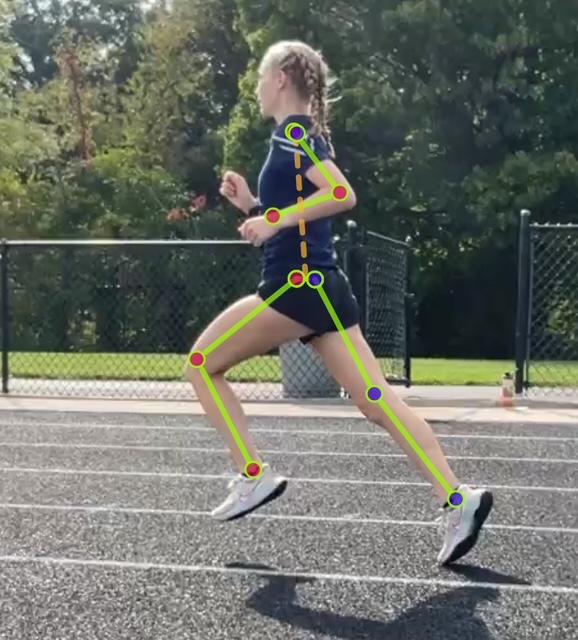
What Steve checks
The details a watch, an app, or a busy team coach won't catch.
Every clip is reviewed frame by frame, in slow motion where it matters. These are the checkpoints in every assessment.
Where the foot lands
Under the hips, or out in front of the knee? A foot that lands too far forward acts like a brake on every step. It slows the athlete down and makes the knees and hips absorb more force than they need to. It's one of the most common things we coach young runners out of.
Stride length and cadence
Overstriding gets the attention, but plenty of kids do the opposite and shuffle. Steve looks at how stride length and turnover work together at the speed your athlete is running.
Bounce
Some up-and-down movement is normal. Too much means energy is going up instead of forward, and the athlete pays for it in every rep.
Head, shoulders, and trunk
Where the head sits, whether the shoulders are tense or up by the ears, and whether the trunk stays stable or twists with each step.
Arm action
Arms that cross the middle of the body or swing loosely leak speed and throw off rhythm. It's hard to see at full speed and obvious in slow motion.
Foot strike
How the foot meets the ground, and whether that fits the speed. A heel strike on an easy run is a different conversation from a heel strike at top speed.
Left and right sides
Whether both sides move the same way, and how freely the hips, knees, and ankles move. Kids who sit through a full school day often show patterns that respond well to a few targeted drills and some mobility work.
Then the focus you choose adds more.
Sprint and speed focus
Adds the start (standing, three-point, or blocks), the first 10 yards of acceleration, and top-speed mechanics: body angle out of the start, pushing behind the hips, knee drive, and staying tall once upright. Built for track sprinters and for football, soccer, lacrosse, baseball, basketball, and other athletes who need straight-line speed.
Distance focus
Adds how form holds up as the pace rises and as the athlete tires: easy pace compared with race pace, rhythm, and the small breakdowns that cost the most over a cross country race or an 800, 1600, or 3200.
How it works
Four steps, all from home.
- 1Choose a focus and check outSprint and speed, or distance. A one-page filming guide follows by email.
- 2Film 30–60 seconds on your phoneNo special equipment. The guide covers the details, and the short version is below.
- 3Upload the clip with parent consentAdd your athlete's age, sport, and what you'd like looked at. Consent is required because the athlete is a minor.
- 4Get a 10–12 minute video backWithin 5–7 business days. Steve walks through the clip in slow motion, names the two or three things worth fixing first, and gives you the drills and cues to use with your athlete. It's yours to keep and share with their school or club coach.
What you'll film
A phone and about a minute.
- Two angles: one from the side, one from the front or behind
- Phone at hip height and held steady, or on a tripod
- Slow motion if your phone has it (most do)
- Fitted clothes so knees, hips, and arms are easy to see
- Sprint focus: a start and a 30–40 yard run at full speed
- Distance focus: one run at easy pace and one at race pace
Order
Choose a focus and a package.
Never had your athlete's running looked at? Start with a single assessment. The three-pack is for parents who want to check progress across a season.
FAQ
Common questions
Who is this for?
Middle school and high school athletes, roughly 11 to 18. That includes track sprinters, cross country and distance runners, and athletes in other sports who need to be faster in a straight line. Steve frames everything for your athlete's age: what matters for an 11-year-old isn't what matters for a 17-year-old.
My athlete plays a field sport. Which focus should I choose?
Sprint and speed. Most of the running in football, soccer, lacrosse, and baseball is short acceleration, and that's what the sprint focus looks at most closely. This is a running assessment, so cutting and change of direction aren't covered.
Is this a medical or injury evaluation?
No. It's a coaching assessment of how your athlete runs. Steve doesn't diagnose or treat injuries. If something in the video looks like it needs a doctor or physical therapist, he'll tell you plainly. See the health disclaimer.
When is the three-pack worth it?
When you want to see whether the changes are sticking. A common pattern is one assessment before the season, one in the middle, and one near the end. Each one is a full review.
What happens after the assessment?
You work on the drills and cues with your athlete. If you want a full periodized plan to run alongside that, the 12-Week Program is in development, and you can join the waitlist.
Is my athlete's video kept private?
Yes. Videos are stored privately, aren't shared, and are never used in marketing without your written consent. Full detail is in the privacy policy.
What if the assessment isn't useful?
If Steve hasn't finished your assessment yet, you can request a refund. Once it's been delivered, refunds aren't available because the work is done. Full terms are in the refund policy.
Ready for an honest look at how your athlete runs?
Choose a focus, check out, and the filming guide follows by email.